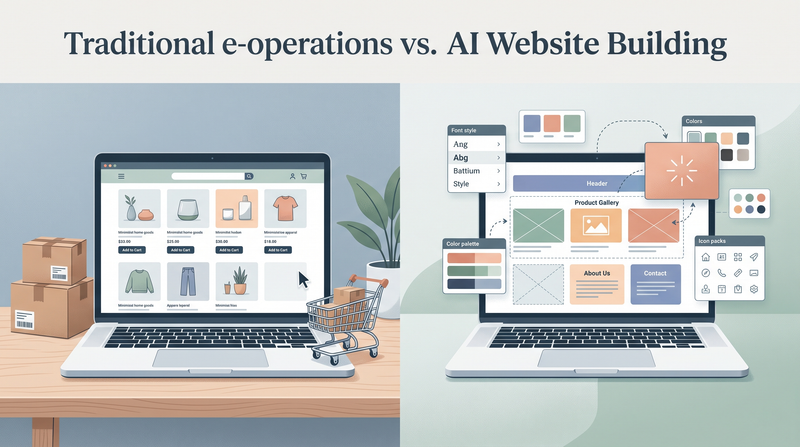
Describe a business in one sentence and an AI builder can produce a polished storefront surprisingly quickly. It can write headlines, create product sections, generate images, and connect a checkout. That makes tools such as Lovable, Base44, and Replit attractive to anyone launching an online business.
But a storefront is only the visible layer of an online store.
If you sell physical products, the harder questions begin after the design is generated: Where will I manage products and stock? Which system handles my shipping rules? Can I edit my store without returning to the AI builder? How many subscriptions and usage-based services will I need after the free trial ends on those AI builders?
That is the practical difference between a general AI builder and a dedicated ecommerce platform such as Jumpseller. The right choice depends less on which tool produces the fastest first screen and more on the system the merchant will operate with every day.
The first hour is easy. The next thousand orders are the real test
AI builders shorten the distance between an idea and a working interface. They are especially useful for:
- Custom applications and interactive experiences;
- Prototypes and early validation;
- Landing pages connected to a simple payment flow;
- Digital products, memberships, and software subscriptions;
- Unique business logic that a standard store does not provide.
Physical ecommerce, with its management and shipping of packages, introduces a set of operational requirements.
A product is not only a name, image, and price. It can have variants, stock levels, shipping dimensions, tax rules, fulfillment states, customer notifications, and return or cancellation workflows.
All of these add up to a level of complexity that starts to distract you from the main goal of the online store: to sell your products and focus on growing your business.
AI ecommerce models at a glance
| Area | Jumpseller | Lovable | Base44 | Replit |
|---|---|---|---|---|
| Primary purpose | Build and operate an online store | Build custom websites and applications with AI | Build full-stack applications with AI | Build and deploy software with AI |
| Physical-product route | Native catalog, checkout, orders, shipping, and fulfillment through Jumpseller | Through Shopify, the generated storefront remains a separate layer | Generates a catalog, cart, checkout, order dashboard, and Stripe flow through Wix | Replit builds and hosts the storefront while Shopify runs ecommerce |
| Design and editing | Premade or AI-generated built with native Jumpseller theme components; edit via chat, visual controls, code, or external AI tools | Constrained to editing the generated application in Lovable | Constrained to editing the generated application in Base44 | Constrained to editing the generated storefront in Replit |
| Payments | Multiple global (Stripe, Paypal) and local gateways (MB WAY, Multibanco) with competitive commissions. You can start using them with one click. | Restricted to Stripe or Paddle directly, with the higher fees associated with them | Restricted to Stripe and Base44 Payments, with the higher fees associated with them | Shopify or a generated Stripe-backed application, with the higher fees associated with them |
| Shipping | Native rates, zones, pickup options, and local carrier integrations (CTT, DPD, etc.) with competitive prices (Jumpseller contract or your own) and one-click setup. | Configuration through Shopify, you have to get the necessary credentials and negotiate a contract with the carrier. | Shipping rules can be built, while a carrier without a native connector requires an API integration and credentials | Shopify handles the shipping through their own dashboard,you have to negotiate a contract with the carrier and get the necessary credencials. |
| Best fit | Merchants who want one operational ecommerce platform | Custom digital experiences, applications, or Shopify-backed storefronts | Custom applications and teams prepared to define their own ecommerce workflows | Custom software and highly tailored Shopify storefronts |
Jumpseller combines AI creation with ecommerce operations
Jumpseller also uses AI to accelerate store creation. A merchant can describe the business and generate a store draft containing a design, pages, products, copy, and images.
The result already lives inside a system designed to manage products and orders. A merchant can continue with the essential work of:
- Organizing products, variants, and categories;
- Tracking inventory and stock locations;
- Configuring checkout and billing information;
- Receiving and managing orders;
- Setting payment and fulfillment statuses;
- Defining shipping rates, zones, and pickup options;
- Connecting invoicing, marketing, and fulfillment services;
- Customizing the theme visually or through code.
This reduces the number of systems that must be designed, connected, tested, and maintained from scratch before the store becomes ready to sell, rather than a concept.
The same AI design freedom, built from working components
You don’t have to choose between an impressive AI-generated design and a functional online store. Jumpseller’s AI website builder can generate a unique, brand-matched layout with images and copy in seconds. The difference is that it generates the design inside Jumpseller’s existing theme and ecommerce system.
This matters after the initial reveal. A design can look as polished and distinctive as one produced in a general AI builder while remaining connected to real products, variants, stock, cart behavior, payment methods, and shipping rules. You are less likely to discover that a generated section cannot be edited in the platform’s theme editor or that the attractive checkout is only a visual approximation.
You can keep improving the store in several ways:
- Use the built-in AI website builder. Describe the store you want and let Jumpseller generate the layout, content, and images inside a working store.
- Talk to the AI assistant in the Visual Editor. Ask it to rearrange sections, change text, adjust the design, or help refine the page without writing code.
- Edit native components directly. Change colors, typography, images, product blocks, banners, sliders, and other section settings visually. All plans allow code editing except Basic, where you can also work directly with HTML, CSS, JavaScript, and Liquid.
- Bring your preferred external AI tool. Connect ChatGPT or Claude to manage the store through Jumpseller’s authenticated MCP connection. For theme development, the open-source Jumpseller AI Toolkit gives Claude Code, OpenAI Codex, and Gemini CLI verified knowledge of Jumpseller Liquid, theme components, the CLI, and the MCP server.
- Build, import, preview, and deploy your own theme. A theme can be created as Jumpseller Liquid and native component files, packaged as a supported theme, imported into the store, and continued in the Visual Editor.
This gives you two levels of freedom. A non-technical merchant can stay inside Jumpseller and work by chat or visual controls. A developer, agency, or advanced merchant can use the code, CLI, API, MCP connection, and an AI coding tool of their choice.
A payment connection does not solve shipping
Stripe makes the checkout step look simple, and tools like Lovable, Base44, or Replit can easily wire up a payment provider.
However, accepting money is only half the battle. Fulfilling a physical order is where logistics get messy, shipping costs depend on destination, weight, dimensions, pickup points, and carrier service levels. With developer-first platforms or AI site builders, connecting a regional carrier (like CTT or Correios) typically means building a custom integration.
Even if the builder generates the code, the merchant is still stuck opening a commercial carrier account, managing API credentials, mapping fields, handling edge-case errors, and renegotiating rates with zero shipping volume to leverage.
Jumpseller removes this operational friction entirely. Instead of forcing merchants to build an integration or sign individual carrier agreements, Jumpseller provides built-in shipping contracts that work out of the box.
- Zero configuration: No carrier API keys, complex field mappings, or developer maintenance required. You simply toggle the service on.
- Volume-discounted rates: Because Jumpseller negotiates shipping agreements using the aggregated order volume of thousands of merchants, even a store launching on day one gets access to competitive commercial rates typically reserved for high-volume retailers.
- Complete flexibility: Alongside these ready-to-use contracts, merchants retain full control with standard flat rates, free shipping thresholds, pickup points, and custom table rates based on weight, price, or delivery zones. A regional carrier without a native contract can still be connected as an external shipping method.
For an independent merchant, the difference is night and day: you don’t own a fragile piece of logistics software, you just print the label and ship.
A Shopify connection can create a two-platform operating cost
Lovable and Replit have both Shopify as the ecommerce foundation for physical products, with Shopify already providing inventory, checkout, tax, shipping, fulfillment, and order management.
The tradeoff is that the merchant may now depend on two platforms instead of one.
Lovable’s free plan currently includes five build credits per day, capped at 30 per month. Its own examples price a small style change at 0.5 credits, removing a footer at 0.9, adding authentication at 1.2, and building a landing page with images at 1.7.
A free allocation may be enough to test an idea, but substantial design iteration can use it quickly. Continued customization may therefore add a second subscription or top-up cost on top of Shopify. If you are weighing Shopify itself against an all-in-one platform, see our full Jumpseller vs Shopify comparison.
The more important question is not only price. It is where routine work happens:
- Can products, collections, and prices be edited in Shopify and appear immediately on the storefront?
- Is the storefront a native Shopify Liquid theme, or a separate application using Shopify APIs?
- Do Shopify theme-editor changes affect the customer-facing site?
- Which platform owns navigation, content, product presentation, and analytics?
- Can the merchant stop using the builder without rebuilding the storefront?
Local payments can matter more than a beautiful checkout
A familiar payment method can be the difference between a completed purchase and an abandoned checkout.
The right mix varies by market. A merchant may need a global card processor, a local bank-transfer method, cash on delivery, or a regional buy-now-pay-later provider. It may also be useful to offer different methods depending on the customer’s shipping destination.
Jumpseller supports more than 30 global and local payment integrations and allows several gateways to be active at the same time. Its shipping-zone system can associate payment and shipping methods with particular countries, regions, or municipalities.
Lovable (requires a Pro plan or above to have it natively, otherwise, you need to connect your own Stripe account manually) and Replit make Stripe or Shopify checkout easier to generate.
Base44 makes Stripe setup approachable through AI chat and supports additional integrations. These are capable options, but the merchant should confirm the pricing of Stripe, as it is usually much more expensive than native integrations of the payment methods.
Which approach is right for your business?
Choose Jumpseller when:
- You primarily sell physical products;
- You need local payment or shipping options;
- You want inventory, checkout, orders, and fulfillment to work together;
- You want to launch without designing a ecommerce backend;
- Your team prefers managing the business through an established admin panel;
- You want AI to accelerate store creation without adding another operational layer;
- You want generated sections to remain editable as native theme components;
- You want the option to use built-in AI, visual editing, theme code, or an external AI coding tool.
Choose Lovable, Base44, Replit, or another general AI builder when:
- The product is mainly a custom web application;
- You sell software, access, memberships, or another digital product;
- A standard ecommerce data model does not fit the business;
- You are validating an idea before investing in a full operation;
- Your team can design, test, secure, and maintain the required workflows;
- Custom interaction and application logic matter more than native ecommerce operations.
Ask one question before choosing
Do you need to generate a website that can accept a payment, or operate a business that can reliably process orders every day?
Lovable, Base44, and Replit can create impressive experiences quickly. Their ecommerce options are becoming more capable, and their Shopify connections solve important backend problems.
They can also introduce a second interface, a second bill, or custom integration work that a non-technical merchant may not anticipate.
Jumpseller combines AI-assisted creation with the catalog, payments, shipping, inventory, orders, and fulfillment tools a store needs after launch.
You can still create an impressive, highly customized design, refine it via chat, edit its native components, work directly with the code, or bring an external AI coding assistant. For merchants who want that creative freedom without making the storefront dependent on a second website builder, choose Jumpseller.